

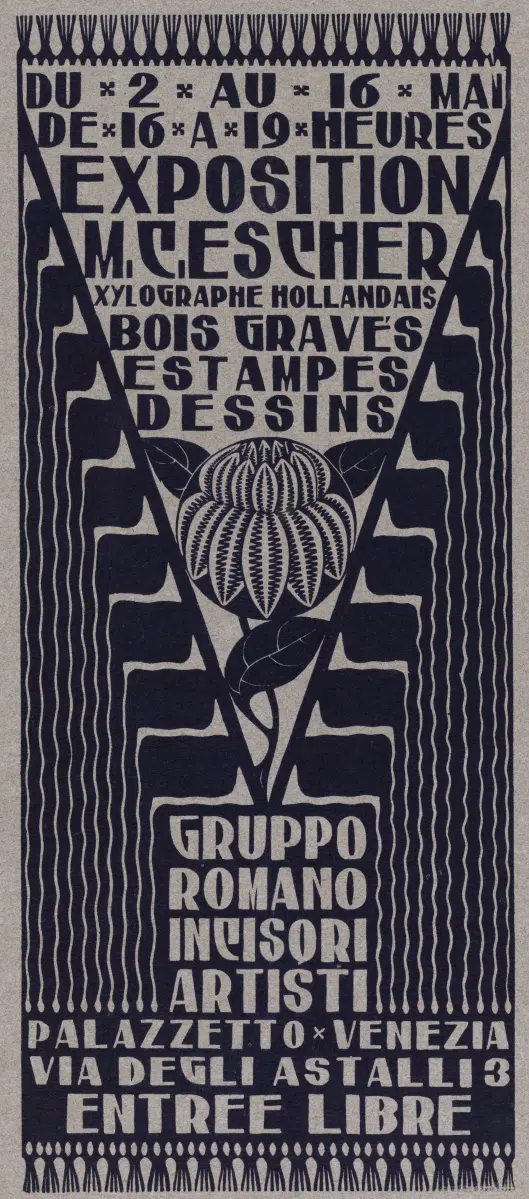
LW110, Announcement of exhibition in Rome 1926.
M.C. Escher’s exhibition in Rome 1926.
Shortly after his marriage to Jetta Umiker, whom he had met during his earlier travels in Italy, Escher ended up in Rome. This was not the original plan, but at that time, no house could be found in Frascati. However, there was an opportunity in Rome: a house under construction was for sale on Via Alessandro Poerio.
It was unavoidable that Escher would eventually meet some of his fellow Dutchmen, among which was Mr. G.J. Hoogewerff, director of the Netherlands Historical Institute in Rome. The latter would assist Escher in his search for exhibition opportunities.
This proved successful following a visit to the Dutch envoy in Rome and to the Pope’s envoy. From May 2nd to May 16th, 68 works were displayed at the Palazzetto Venezia. This was his first solo exhibition of this scale and would prove to be a success.
The Dutch and Italian (Rome) press wrote about the event :
” Among the woodcuts, too, there are several purely Italian subjects, but here another side, a different current, is also evident. Some witty illustrations were created for the poetic prose work ‘Flor de Pascua’ by Mr. A. van Stolk. A Saint Francis of Nordic character preaches to a multitude of mischievous birds. The legend of Saint Vincent is strikingly rendered according to the Legenda Aurea by Jacobus van Voragine, and with the latest series—six visions of the days of creation according to Genesis—the xylographer strikes a deeper tone. The parting of the waters, for example, is impressively depicted. ” Nieuw Rotterdamsche Courant, may 1926.
“A Dutchman exhibiting in Rome is not an everyday occurrence, although Dutch people and Dutch artists frequently feel so much enthusiasm and are so inspired by the beauty of Italy in nature and art that they settle there, just as, among others, Miss Maria van Panhuys has set up a sculpture studio in Rome. But Mr. Escher is neither a sculptor nor a painter, and does not wish to be a painter either, he declared to me on the occasion of a visit to his exhibition of woodcuts and drawings in the palace of Venice. This exhibition is fully worth a visit. ” De Tijd, may 1926.
Exhibition of Drawings and Woodcuts by M. C. Escher.
An exhibition of drawings and woodcuts by Dutch artist M. C. Escher has opened at the premises of the Gruppo Incieri Romani at Via degli Astalli 3 (Palazzetto Venezia).It is a fairly homogeneous collection of works in the imaginative and arbitrary manner of which Nordic illustrators are masters. Skillful execution, richness of means, and, ultimately, highly successful execution.These things, however, are beyond our taste, and may seem banal, but it’s all done for earthly pleasures: in other words, what, for these foreigners, signifies refinement and idealism, to us almost always smacks of the sick and theoretical.But this shouldn’t rule out artistic potential in this mode of expression.Indeed, in the works of the young Dutchman, one often senses a pleasant and delightful sense of invention and style;at other times a festive and luminous decorativeness; and, finally, always a just balance of black and white ratios, the sovereign reason for this art, entirely written and engraved. The artist’s subjects are generally Italian landscapes, visions of Siena, Assisi, Rome, and Amalfi … ” Tribuna, Correire d’Italia, Rome, may 1926, C.E. Oppo. (full text in italian)
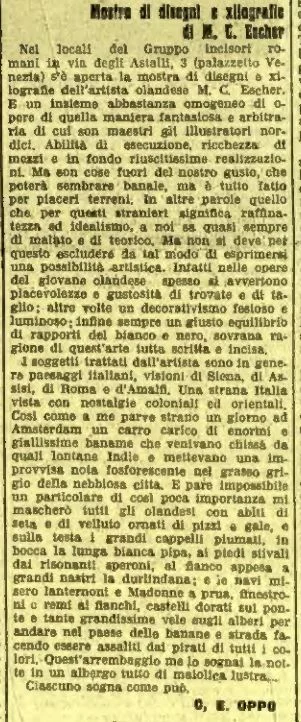
Tribuna , Correire d’Italia, Rome, may 1927.
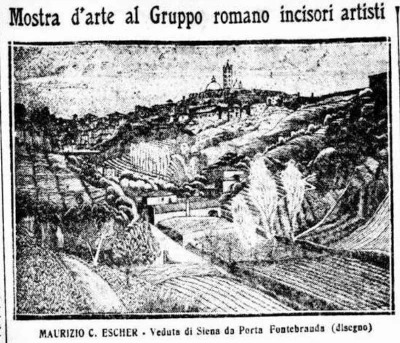
Il Messaggero, Rome, may 1926.
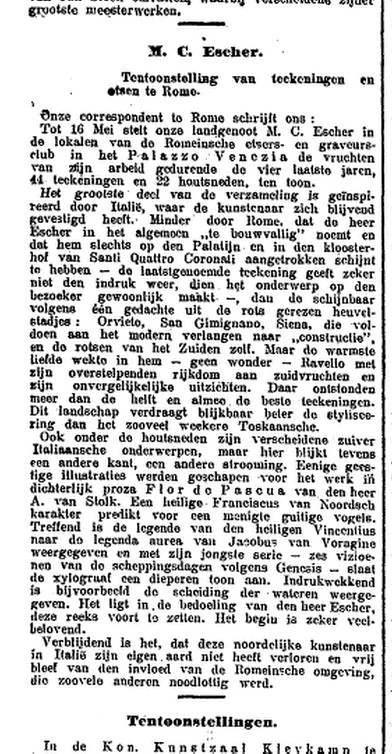
Nieuwe Rotterdamse Courant, may 1927.
Published : May 2026. Last updated : August 31, 2026
